

Plymouth is a resilient city.
Its story is written in waves of change. It has been reshaped by war, rebuilt with ambition, and reinvented by the communities who call it home. Through all of that runs a quiet motto carved into the city’s identity. Resurgam. I shall rise again.
You can feel that spirit in Plymouth today.
You see it in the crowds that gather for things like #GeddonPlymouth, when thousands of people fill the city centre not because they have to, but because they want to celebrate creativity together. You see it in the energy behind the city’s 2029 City of Culture bid, in the artists, organisers, and communities who believe Plymouth’s story is still unfolding.
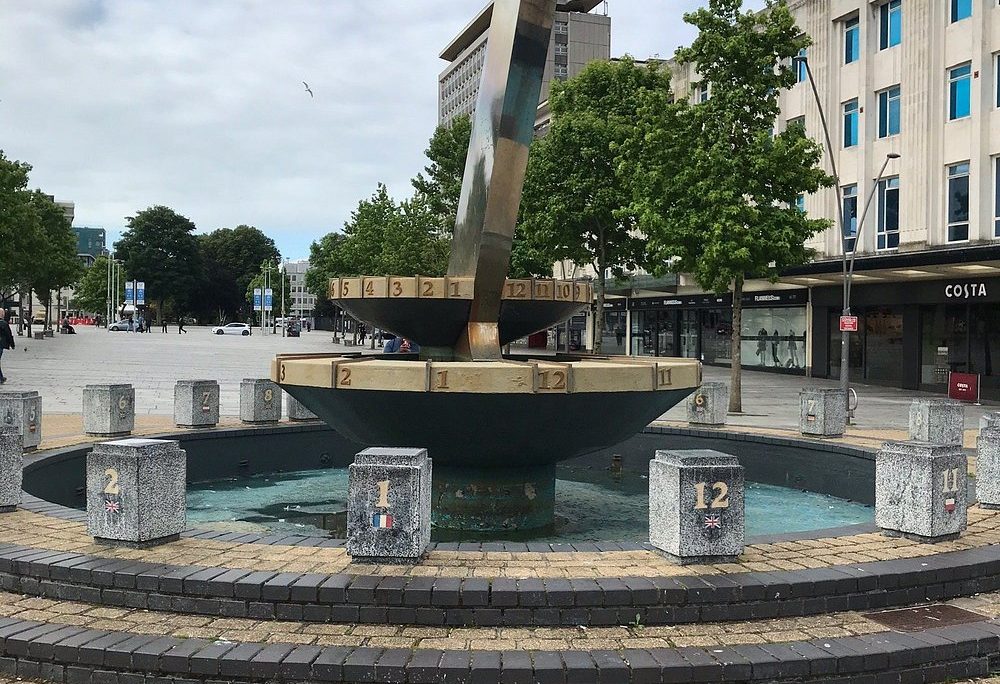
And you see it in the way Armada Way is being transformed.
Historically, city centres are organised around consumption. Move through here. Buy something there. Continue on your way. Efficient perhaps, but not especially joyful.
The new Armada Way imagines something different. Trees, play spaces, water, places to sit, places to gather. A city centre designed not only for movement, but for curiosity, conversation, and time spent together.
That idea stayed with me.
I began to wonder what might happen if the city did more than simply host people. What if it could respond?
Signal Garden began with a small technological curiosity. Capacitive sensors can detect touch through ordinary materials. Tiny microcontrollers can translate those signals. Small hidden speakers can respond with sound. Connect these things together and something surprising happens.
A railing can notice a hand.
A bench can hum softly.
A stone can sing.
Technically the system is simple: Touch surface > Sensor > Sound > Hidden speaker. The electronics are modest enough to run from a battery and hide easily within the everyday fabric of the city.
But the technology is not the point.
The point is the moment that follows.
Someone touches a surface and hears a tone bloom quietly in the air. Another person notices and tries it themselves. A second note appears. A third stranger joins and suddenly a small chord forms between people who have never met.
For a few seconds our city becomes an instrument, and this is the heart of the experiment.
Signal Garden is a prototype. A playful exploration into how lightweight interactive technology might invite curiosity and shared discovery in public space. We want to know:
What happens when our city listens back?
In a world that can often feel noisy and uncertain, Brooke and I are increasingly drawn toward the idea of radical joy. The belief that optimism, creativity, and curiosity are not naive responses to difficult times, but tools for shaping better ones.
Plymouth already understands this instinct. It is a city that keeps finding new ways to rise, again and again, through imagination and collective effort, going hundreds of years back into our history.
Signal Garden is a small prototype, but it asks a big question. If cities can be designed for curiosity rather than consumption, what else might become possible when people are invited to participate instead of simply pass through?